A House Passed Down Through Generations
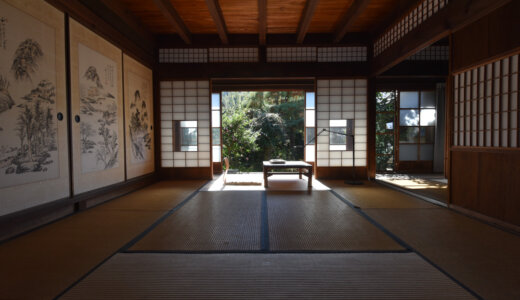
My home is an Ishibadate (石場建て) house constructed by my great-grandfather, and I am the fifth generation to live here. I was born and raised in this house, and now my children, the sixth generation, are growing up here. The house has a traditional square layout, with Shoji (障子) sliding doors and Tatami (畳) mats. To keep cool during the hot summer months we use electric fans, while Kotatsu (炬燵) tables and wood-burning stoves keep us warm throughout the cold winter. Surrounding the house are gardens with old trees such as oak, camellia, and persimmon, along with fields and rice paddies. We live our daily lives working in and together with our natural environment, such as raising and caring for chickens and maintaining rice paddies.
This house, built by an ordinary carpenter during the Meiji era (1868–1912), can be lived in indefinitely by continually replacing tiles and repairing any areas in poor condition. Constructed from natural materials such as wood, earth and straw, this breathing house grows alongside us, bestowing upon us a richly rewarding passage of time.
Within the ancient soil, among old stone walls and foundation stones, moss-covered ground and vegetation, fungal mycelium and plant roots spread, while insects and other creatures make their homes. The diverse life inhabiting this soil circulates air and water within it, thereby allowing the earth to breathe and bring us pleasant breezes together with changing seasons.
Until quite recently, I was constantly searching for a way to express the merits of my beloved home to others. A comfortable house enveloped in natural materials, a house that ages rather than becoming dirty, a natural garden where even weeds appear beautiful, a house and garden that endure and become vessels for family memories… None of these descriptions are wrong, but when asked if that was the reason for it being passed down for generations, it didn’t quite feel right.
However, I have finally found the answer. It is that my home gives me the joy of tending to and nurturing my house and garden.
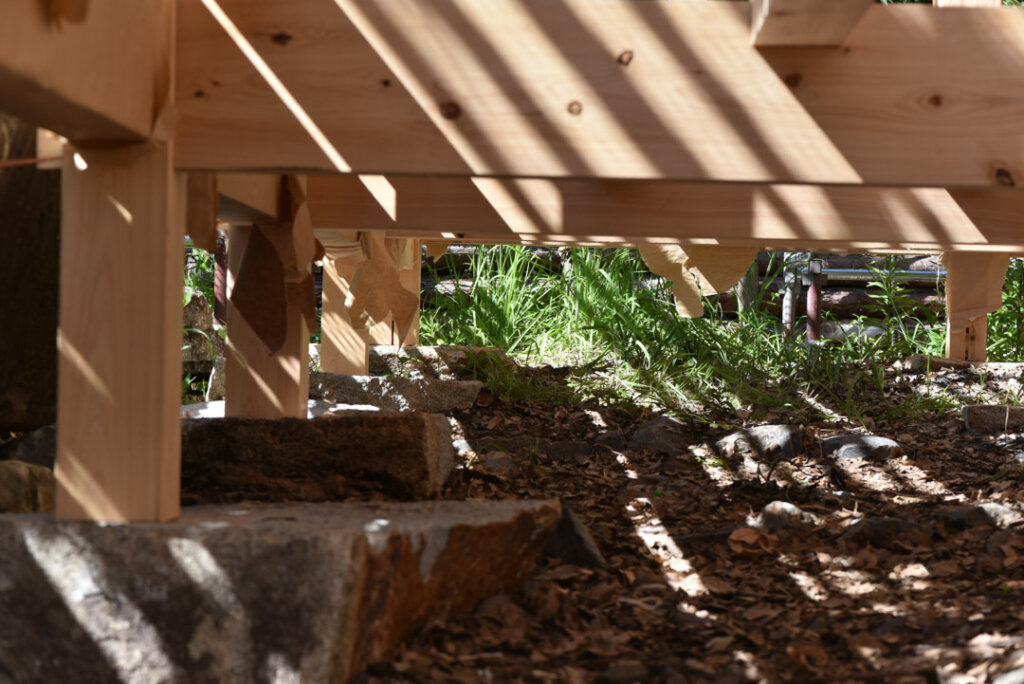
Houses and soil crafted to breathe freely can deepen that quality with a little care from us, growing and developing slowly over time. For instance, replacing Shoji paper, cleaning corridors as well as wiping down pillars and beams, lifting Tatami mats to clean the En no Shita (縁の下) space under the floor, undertaking minor carpentry projects, or outdoor tasks like pruning trees, mowing grass and maintaining rainwater drains. The depth of a century-old house and its soil, the joy of watching it grow day by day – it is for these pleasures that I continue to live here.
The Architecture of Ishibadate
My journey into architecture began in 2010, after I had passed the age of thirty. I started out building houses using modern construction methods, but after much trial and error, I arrived at the Ishibadate house – a house that felt like “my home”.
The three things I particularly value are as follows. Firstly, using genuine natural materials to create homes that will deepen in character over a hundred years. The first house I worked on employed modern construction methods, with almost all the materials being industrially made products. Plywood, laminated timber, insulation, vinyl, plasterboard, concrete – the thought that all these might become waste within decades made me shudder. I was also shocked to learn that these materials could have adverse health effects, and that the entire house must be ventilated regularly.
Building a house using only materials that breathe and are alive, cause no adverse health effects and can be returned to the earth requires the skilled craftsmanship of artisans who understand the properties of the materials and their interactions.
Secondly, to build homes that can be passed down for a hundred years, we must construct houses suited to Japan’s climate and natural conditions. In earthquake-prone Japan, can modern construction methods—relying on plywood and metal fittings for seismic reinforcement—truly withstand multiple earthquakes and endure for a century? Following the Kumamoto Earthquake, 35,000 damaged buildings were demolished at public expense. The amplification rate of surface ground vibrations proved far more significant than anticipated. The few houses that survived the quake were not inherently earthquake-resistant structures, but rather those designed for easy repair after damage. Furthermore, in Japan’s hot and humid climate, houses are often covered with waterproof sheets and tape to combat dampness, leaks, and improve airtightness. However, these can tear during earthquakes or deteriorate over time, potentially allowing water ingress.
To build homes that endure in Japan’s climate and environment, it is essential that they be easy to repair and maintain after disasters, feature a structure that dries readily even when not sheltered from rain, and employ materials that can breathe by being exposed to air. In other words, Shinkabe (真壁) construction – where structure and design are one – was required.
Thirdly, energy-efficient home construction for the future. This means building homes with a low total energy footprint across: 1. Production and Construction, 2. Operational Use, and 3. Demolition and Disposal. Currently, to reduce electricity and gas usage, we introduce building materials like insulation and sash windows, along with energy-saving equipment, and install solar panels to generate electricity. However, the focus seems to be solely on minimising energy consumption during operation (2.), while the impacts of production and construction (1.) and demolition/disposal (3.), or the effects on the surrounding nature, appear to be overlooked. Solar panels and wind turbines, which are built by destroying nature, are similar. While they currently appear justified because the energy generated during operation (2.) is substantial, this balance will eventually reverse. At that point, reducing both production/construction (1.) and demolition/disposal (3.) will be required.
What we must do now is to simultaneously reduce the scale of all three: 1, 2, and 3. To achieve this, we must build homes that return to the earth after a hundred years, not ones that become rubbish after thirty. We must rely on the sun and wind, harness the humidity-regulating and heat-storing properties of earth, wood, and straw, and devise ways of living attuned to the local climate and natural environment.
The Natural Engineering of Ishibadate
In 2020, encountering a certain book inspired me to pursue a form of house-building that nurtures nature through its construction. That book was Hiroomi Takada’s “土中環境” (Dochū Kankyō = The Natural Environment and Ecosystem of the Earth), published by 建築資料研究社 (Kenchiku Shiryō Kenkyūsha) in 2020. Even though Ishibadate construction places a smaller burden on nature, it still involves destroying nature to build a house. How can we make it sustainable and contribute to nature’s regeneration? The answer lay not in architecture, but in civil, or more accurately, natural engineering.
My house has an inner courtyard, some 20 tsubo (approx. 66 m2) in size, which predates the house itself. It is a garden of diverse trees, from tall to low, with moss-covered cedar, a stone-piled mound, three large stone-lined hollows, and stepping stones encircling the space. My grandfather tended to this garden daily. The large stone-lined hollows would drink up the rainwater from the roof, and nearly every acorn that fell from the oak would sprout. In summer, the room facing this garden was somehow cooler and had fewer mosquitoes. I had always thought of it as a mysterious garden since childhood, but reading Dochū Kankyō revealed why. Soil grows by breathing too. It is nurtured by living things like plants and insects; humans can merely provide the catalyst. The trees in this garden spread their roots beneath the foundation stones of the house, with my home standing upon those roots. I realised that the Ishibadate houses built by people long ago were nurturing nature.
I had believed human actions were only destroying nature, but learning that there exists a way to nurture it brought tears of joy to my eyes. And to think the key lay beneath the Ishibadate house…
The scope of natural engineering extends beyond the site itself to encompass the surrounding area. For instance, the primary materials constituting an Ishibadate house are sourced from readily available natural resources. Timber harvested from the mountains for thinning or road construction is utilised for pillars, beams, furniture, and wooden stakes. Rice is cultivated in paddy fields, with the by-product straw used for ropes, plastering materials, and tatami mats, while clay is employed for earthen walls. Maintaining bamboo groves and thatch fields provides materials for bamboo latticework and thatched roofs, as well as tools for daily life.
Such places are known as Satoyama (里山). I had always thought that building houses using natural materials placed some burden on nature. However, I came to understand that authentic Satoyama are places where humans and living creatures coexist. By interacting with the land correctly, without damaging it, humans have maintained diverse natural environments, fostered biodiversity, and enriched the land.
This means that producing building materials can contribute to the regeneration of Satoyama landscapes. When constructing an Ishibadate house, we can restore more nature than was disturbed during its creation through the production of the materials. The act of building homes – an essential part of human life – can nurture nature just as insects and other creatures do, benefiting future generations. Could there be any greater joy?
An Ishibadate house not only ensures the home is passed down through generations, but also helps the local community endure over time.
Final Thoughts
My architectural teacher is my home itself, and the work of craftsmen from a hundred years ago. Though I still have much to learn, I wish to preserve as many Ishibadate houses as possible, so that what I have been taught may be passed on to the future. And just as Rudofsky once discovered outstanding architecture, I aspire to create houses that will be featured in “Architecture Without Architects” a hundred years from now – houses built together with material producers, craftsmen, and the homeowners themselves.
October 2023
Tomohiro Mizuno (Mizuno Architectural Bureau)